


ESPRESSO MACHINES & COFFEE GRINDERS...
BUZZ Coffee Beans
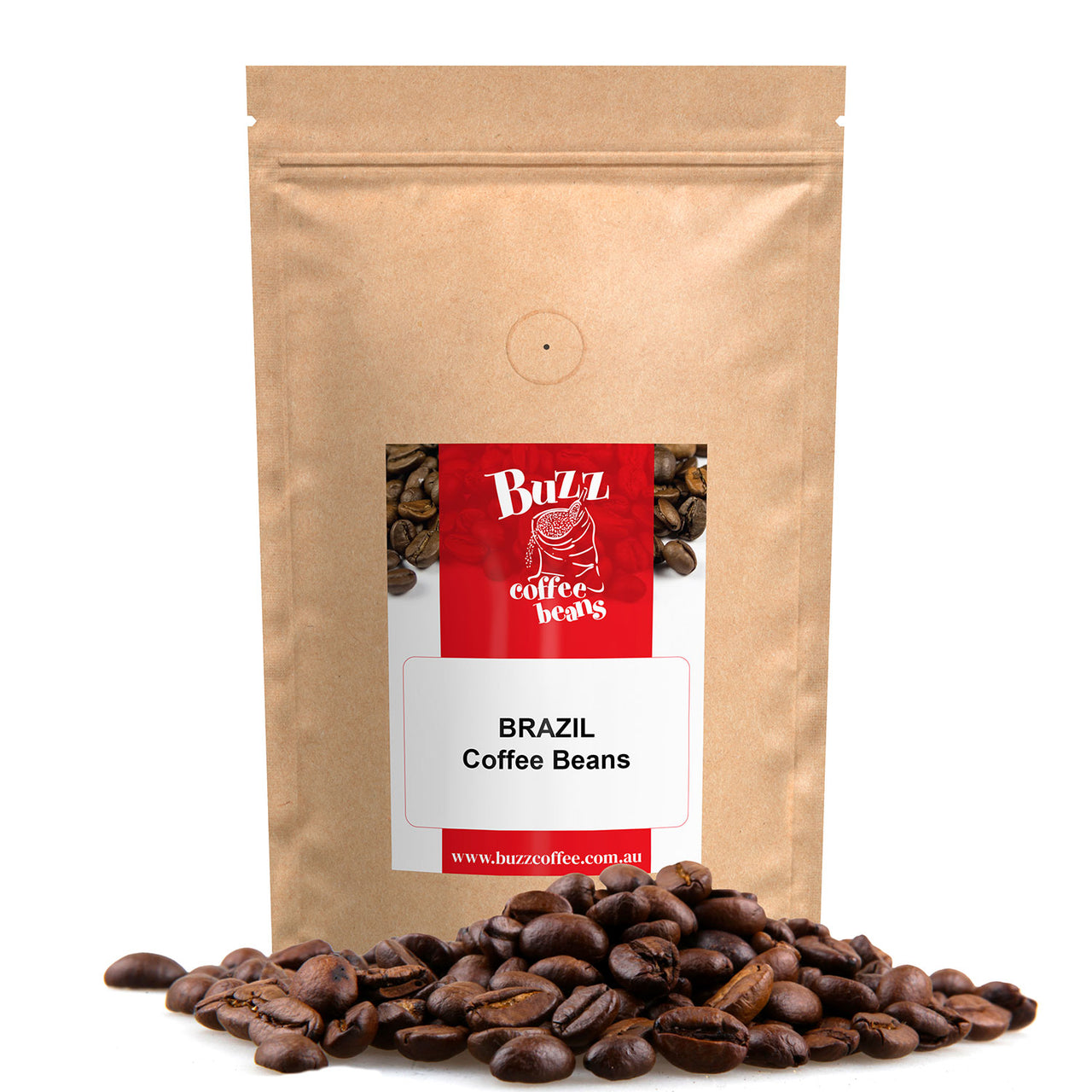
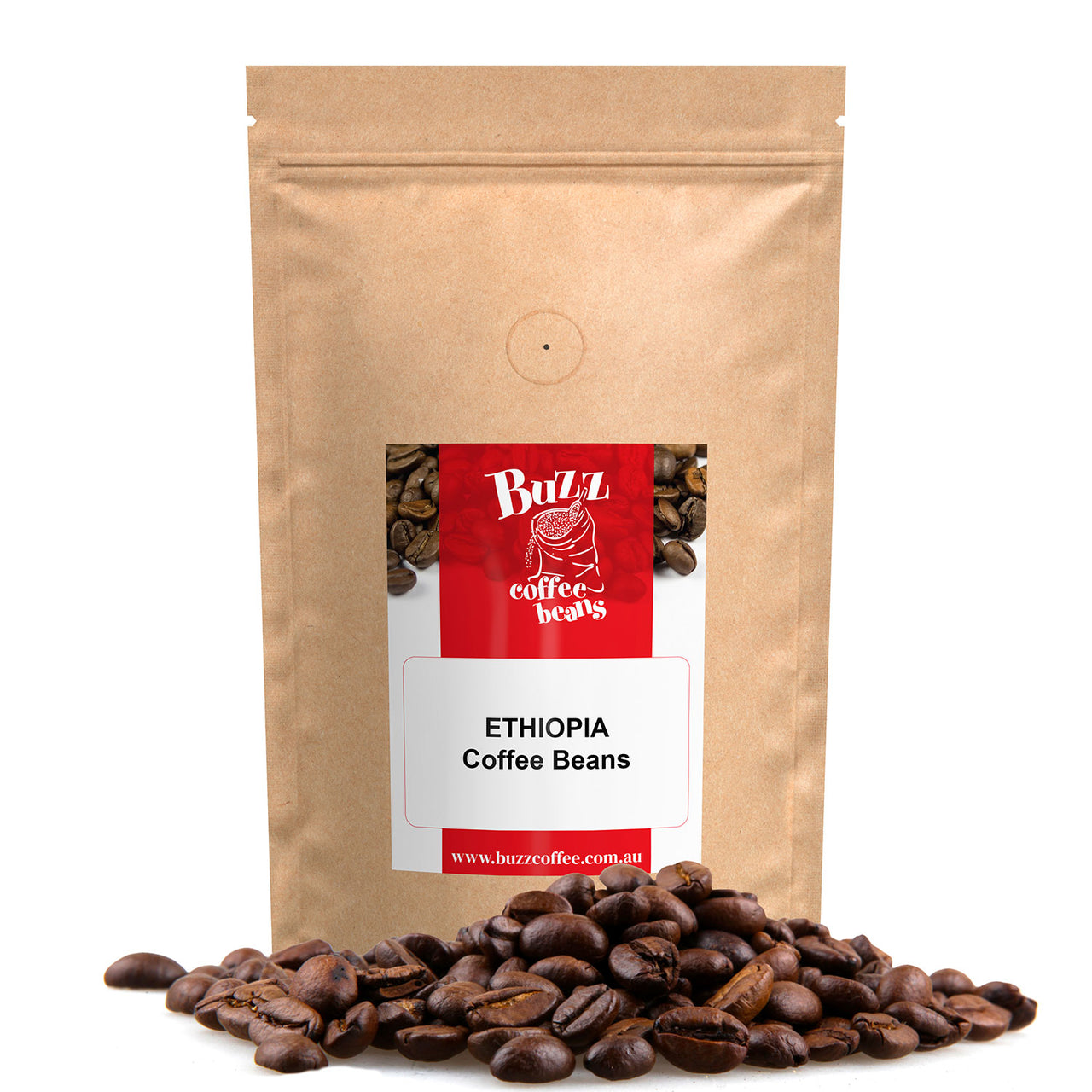
Ethiopian Coffee Beans - Yirgacheffe Region
from $17.00
Ethiopian Yirgacheffe Coffee Beans
Ethiopia is the birthplace of coffee: it is in the Kaffa region's forests that Coffee Arabica beans grew wild. Coffee is "Bun" or "Buna" in Ethiopia, so Coffee Bean is quite possibly a flawed anglicized interpretation of "Kaffa Bun".
We consider Ethiopian coffees to be some of the best in the world. This Yirgacheffe is regarded as one of the best in the world.
Yirgacheffe Coffee has a sweet, fruity aroma with spice and a taste of toffee and lemon. It sounds a little different, but you will go back again and again once you have tried it.
The Region
The Cream of the Ethiopian Crop" – This distinctive Ethiopian Yirgacheffe coffee is grown high in the mountains in a tiny area of the Sidamo region.
It is likely that in and around this region is where coffee had its beginnings. Here the Ethiopian coffees grow gradually and for that reason have more time to absorb nutrients as well as establish more robust tastes based on the local environment and dirt conditions. The most distinctive flavour notes discovered are lemon and citrus with a brilliant acidity level.
Coffea Arabica was also found in the Harar region quite early, either brought from the Kaffa forests or closer areas around the Sudan border. It is entirely possible that slaves taken from the forests chewed coffee cherry and spit out the seeds, thus spreading it into the Harar region, through which the Muslim slave trade route passed.
BUZZ Coffee now sells its entire range of specialty blends and single origin coffee online in Australia. Buy some BUZZ coffee beans online today.
What is so special about Ethiopian coffee?
Ethiopian coffee is special because it is considered the original coffee, with Ethiopia being the birthplace of the Arabica plant. The beans, when properly roasted, exhibit a flavor profile akin to that of a fine wine. The growing conditions in Ethiopia, with mountainside farms or Fincas situated between 1500 and 2200 meters above sea level, contribute to the unique flavor characteristics. Furthermore, the different regions like Sidamo, Limu, Harrar, and Yirgacheffe each add their distinct notes to the beans. Notably, the beans are processed using traditional methods, including wet processing and careful drying, ensuring high quality.
Why is Ethiopian coffee so expensive?
The price of Ethiopian coffee is influenced by its quality and the rigorous methods of cultivation, processing, and quality control. Growing the coffee involves careful cultivation at high elevations, requiring significant labor and resources. Moreover, processing these beans involves washing or wet processing, followed by careful drying, which is labor-intensive. Additionally, Ethiopian coffee's esteemed reputation among farmers and the demand for its unique flavor profiles contribute to its higher cost.
Does Ethiopia have the best coffee beans in the world?
As the birthplace of the Arabica plant, Ethiopia has a long and storied history of coffee cultivation, coffee production and consumption. With its single origin coffee beans grown in diverse conditions and processed using traditional methods, Ethiopia is widely acknowledged for its superior coffee. Beans from the region of Sidamo, for example, are praised for their freshness and overall sweetness. The coffee beans from the Yirgacheffe region are famous for their rich earthy body, soft spice, and bright zesty notes. It's safe to say that Ethiopian coffee is among the best in the world, with a unique taste profile that coffee connoisseurs adore.
Are Ethiopian coffee beans high in caffeine?
Ethiopian coffee does not necessarily have a higher caffeine content compared to other coffees brewed elsewhere. The caffeine content in Ethiopian coffee beans is generally around 1.13 percent. It's worth noting that the roasting process can affect the caffeine content, with darker roasts often having less caffeine as more is burnt off during the process. Thus, Ethiopian coffee is a unique and cherished coffee commodity, celebrated for its distinctive flavor profiles and its deep-rooted history in the world of coffee. australia ethiopia coffee beans
Ethiopian coffee beans have a distinct, irresistible taste, and to coffee connoisseurs, nothing compares to Ethiopian coffee beans. The birthplace of coffee, Ethiopia is renowned for its Ethiopian coffee beans. These Ethiopian coffee beans grow at high altitudes, offering unique flavors. Every sip of coffee brewed from Ethiopian coffee beans is like a journey, transporting you to the lush, green Ethiopian highlands where these Ethiopian coffee beans are cultivated.
Ethiopian coffee beans vary in taste depending on the region, each bringing unique characteristics to the Ethiopian coffee beans. Some Ethiopian coffee beans are fruity, others floral, but all Ethiopian coffee beans are undoubtedly delicious. The meticulous care taken during the cultivation, harvesting, and processing of Ethiopian coffee beans ensures the beans retain their quality.
It's the Ethiopian coffee beans that make Ethiopian coffee stand out in the world of coffee. Coffee lovers often find themselves returning to Ethiopian coffee beans due to their consistency in delivering an unrivaled coffee experience. It is this rich flavor profile and aroma that make Ethiopian coffee beans coveted globally. Ethiopian coffee beans are truly a treasure of the coffee world.
Acidity: High, bright, lemon citrus
Body: Medium
Aroma: Lemon, honey, frangipani, jasmine
Flavour: Rich honey, lemon and kumquat flavours abound with a toffee and caramel finish.
BUZZ Coffee Beans
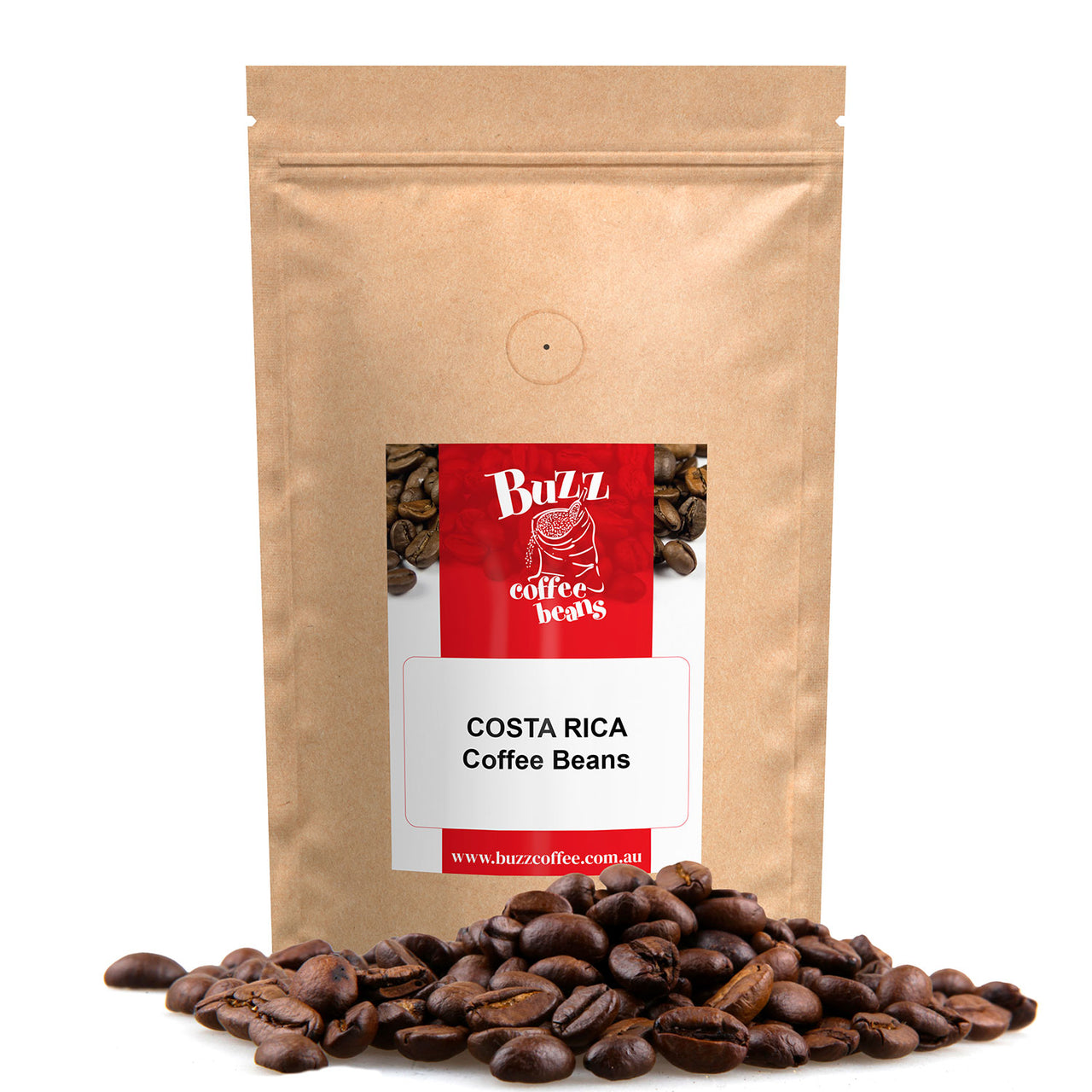
Costa Rica Coffee Beans
from $17.00
Costa Rica Coffee Beans -
Costa Rica Hacienda Sonora
Coffee cherries from Hacienda Sonora in Costa Rica's Central Valley are meticulously hand-picked to ensure quality control. Recognised by the “Cup of Excellence,” this coffee is highly esteemed.
Upon pouring, the aroma will captivate your senses. You will discern and subsequently taste notes of hazelnut, dark chocolate, orange, and red apple, culminating in a clean, honey-like finish.
The Region
Hacienda Sonora is situated at the base of the active Poás Volcano in Costa Rica's Central Valley. Of its 100 hectares, 65 are dedicated to shade-grown coffee, 10 to sugarcane, and 25 to a wild forest reserve.
Alberto Guardia commenced coffee cultivation at Hacienda Sonora 45 years ago. The farm’s coffee is grown amidst native trees and diverse vegetation, enriched by volcanic ash, creating an optimal environment for cultivating high-quality coffee. This biodiversity also attracts a variety of bird and animal species.
The farm is renowned for producing premium micro-lots with distinct varietal and processing separation, while prioritising environmental sustainability. All energy used on the farm is entirely renewable, generated on-site to power both the mill and the workers' electricity.
Indulge in your Costa Rica coffee from BUZZ Coffee.
What is special about Costa Rica coffee?
Costa Rica coffee is renowned for its exceptional quality and unique taste. The combination of the rich volcanic soil, high altitudes, and favourable climate has resulted in a coffee that stands out in the global market. Costa Rica is also the only country that has made it illegal to grow anything but the highest quality Arabica coffee plants. The costa rica coffee taste is often described as bright, clean, and balanced, with complex flavours that differ across the coffee regions.
Is Costa Rica coffee good?
Absolutely, Costa Rica coffee is not just good; it's considered among the best in the world. The Costa Rican coffee industry is marked by strict standards and innovative farming techniques. This ensures that only the ripest coffee cherries are picked, and the beans are processed with utmost care. The unique flavour profile, including the shade-grown beans that contribute to a better taste, makes Costa Rican coffee a favourite among connoisseurs.
What is Costa Rica's most famous coffee?
Among the costa rican coffees, the beans from the Central Valley region are perhaps the most well-known. This area, with its volcanic soil and high altitude, produces coffee that is rich and full-bodied with bright acidity. Brands like Café Britt have become synonymous with Costa Rican coffee, offering single origin varieties that highlight the best of the nation's coffee plantations.
Is Costa Rican coffee the best in the world?
While preferences in coffee can be subjective, many coffee lovers and experts consider Costa Rican coffee to be among the best in the world. The country's commitment to quality, from growing to processing, sets a standard that few can match. The use of Arabica beans, careful handpicking of coffee cherries, and environmentally friendly processing all contribute to a product that's hard to beat.
The rich terrain and various microclimates create a diversity in flavour across the different coffee regions. Each of Costa Rica's eight coffee-producing regions offers something unique. Whether you are enjoying a cup from the Central Valley or Tarrazú, the commonality you will find is exceptional quality.
In the global market, Costa Rican coffee has a reputation for excellence, and its beans are often used to enhance the flavour of other blends. The careful cultivation on coffee plantations, commitment to environmentally friendly practices, and the innovative use of materials like wood clippings from pruned coffee trees and parchment from drying mills, further elevate the status of Costa Rican coffee.
The collaboration of nature and human artistry in the form of soil, climate, and dedicated farmers has given the world the gift of Costa Rican coffee. For those who appreciate a cup that's aromatic, flavourful, and ethically produced, Costa Rica's offerings are hard to surpass. Whether in terms of taste or industry practices, Costa Rican coffee remains a benchmark for quality, and a sip of it is enough to understand why.
Costa Rica is a nation celebrated for its coffee growing expertise. The beautiful landscape of Costa Rica offers an ideal environment for coffee production, with rich volcanic soil and favourable climatic conditions. Costa Rica's commitment to quality is evident in its coffee farming practices, where Arabica beans are cultivated with care. Costa Rican coffees are known for their complex flavours and vibrant aromas, attracting coffee connoisseurs from around the world.
In Costa Rica, coffee farming is more than a business; it's a part of the cultural heritage. Costa Rican coffees are grown across various regions, each contributing unique notes to the beans. The government of Costa Rica has taken steps to ensure that coffee growing adheres to high standards, supporting farmers and ensuring sustainable practices in coffee production.
Whether you are a coffee connoisseur or just enjoy a great cup, Costa Rica's dedication to coffee farming, coffee production, and coffee growing shines through in every cup. The exceptional quality of Costa Rican coffees reflects the nation's love and respect for the craft, making Costa Rica a top destination for coffee lovers worldwide.
BUZZ Coffee Beans
Sumatra Coffee Beans
from $17.00
Sumatran Coffee Beans -
Mandheling Kuda Mas
The best Sumatran coffee beans are highly regarded as one of the world's best. It is one of our best sellers.
This is a coffee for those who love their coffee rich, strong, and very full-bodied. It loves to be with milk in the classic range of coffee drinks; however, as a black coffee, a heady delight awaits you.
Discover why when your order arrives in your post box.
The Region
Most coffee in Indonesia is grown on small-holder farms, a family with anywhere between 100 trees to a few land areas. They pick the coffee and pulp it, which means that they run it through a hand-crank drum with a surface like a cheese grater that peels off the fruit's skin.
Then they will ferment the coffee in any number of ways - either in a polypropylene bag, a plastic tub, or a concrete tank - to get the fruit layer (mucilage) to break down.
After overnight fermentation, the mucilage can be washed off, and you have wet parchment coffee - the green bean inside the parchment layer that encompasses it, still swollen with water.
Since 2016, Sumatran coffees have ended up being more difficult to source because of lower harvest volumes brought on by irregular or extreme climate patterns throughout the expanding and refining periods.
Heavy rainfalls at the incorrect time can spoil plants or ruin coffees that are chosen and drying out in the damp hull approach.
Costs for Sumatran coffees remain to increase. They currently require top dollar on the market, so import brokers and traders are usually downsizing their sourcing, which directly influences what Australia coffee roasters can buy.
It is best as a single origin but will blend with other coffee beans.
Acidity: Low to medium
Body: Bold intensity.
Aroma: Roast caramel, spiced fruit.
Flavour: Intense, earthy, forest berries and smooth.
What is so special about Sumatra coffee?
Sumatra coffee, originating from the Indonesian island of Sumatra, is renowned for its unique processing method called "wet hulling" or "giling basah". This method results in a coffee that exhibits bold flavors and a distinctive earthy taste, which sets it apart from other coffees, including African coffees. The wet-hulled process, coupled with the rich volcanic soil of Sumatra, particularly around Lake Toba, imbues the beans with a flavor profile that is as unique as the region it comes from.
How is Sumatra coffee different?
Sumatra coffee is different due to its wet hulling process, which involves removing the bean’s hull while it's still damp, a method distinct to this Indonesian island. This processing method, along with Sumatra's rich, fertile soil and tropical climate, contributes to the fresh earth and bold flavors that have become a signature of Sumatra coffee. Unlike other beans that are processed using dry or washed methods, the wet hulling method gives Sumatra coffee its unique flavor and low acidity.
What is the difference between Arabica and Sumatra coffee?
While Sumatra coffee is primarily composed of Arabica beans, the term "Arabica coffee" generally refers to coffee made from Coffea Arabica, one of the most widely grown coffee species in the world. Arabica coffee can vary significantly in taste depending on its origin and processing method. Sumatra coffee, on the other hand, specifically refers to coffee grown and processed on the island of Sumatra, utilizing the unique wet-hulled method. Thus, while Sumatra coffee is a type of Arabica coffee, its unique processing and terroir give it a distinctive taste profile that's rich, earthy, and full-bodied.
What is the Flavor of Sumatra coffee?
The tasting notes of Sumatra coffee are quite distinct. It is known for its full-bodied, rich, and earthy flavor, often accompanied by a low acidity and a touch of spice or herbal notes. Unlike the bright and fruity notes found in some African coffees, Sumatra coffee possesses an intense, fresh earth quality that many coffee lovers find intriguing. After roasting, the beans produce a fresh roasted, slightly spicy aroma that is unmistakably Sumatran. The wet hulling process enhances these flavors, providing a depth and complexity that sets Sumatra coffee apart.
Whether you prefer a light roast or a darker roast, Sumatra coffee always brings something special to the cup. It's the taste of the Indonesian island – an exotic, full-bodied brew that is as exciting as it is satisfying. With each sip, you're tasting the product of a unique process, a unique climate, and a unique soil - all of which make Sumatra coffee the treasure that it is.
BUZZ Coffee Beans
Indian Monsoon Malabar Coffee Beans
from $17.00
Indian Monsoon Malabar Coffee Beans
Taste notes – “Thick, chocolatey, lots of character, light almost savoury notes”
The pungent aroma of Indian Monsoon Malabar Coffee will fill the room and prepare your palate for the flavours of treacle, toffee, and a long chocolate finish.
Our BUZZ Indian Monsoon Malabar Coffee takes people by surprise as not many realise India grows premium coffee beans.
Your Coffee loving taste buds will be excited at the new flavour. Once you have enjoyed Monsoon Malabar Coffee, you will be buying it often.
While most people think tea is India's best-recognised beverage, Indian Coffee is incomparable. India grew Coffee because of the early 18th Century need in Europe.
Varied climatic conditions, and farming practices such as expanding seasonings, indigenous fruits, and vegetables as intercrops, resulted in intricate flavours unique to Indian coffees.
Most of these coffees originate from the vineyard belt that spans the southern Indian states of Karnataka, Tamil Nadu, and Kerala.
The Region
Malabar is in the Southwest region of India close to Kerala and Kamataka. It has ideal conditions to develop its unique characteristics and has protected status in India by Government decree.
The typical Indian Monsoon Malabar is a dry-processed coffee exposed to moisture-laden monsoon winds for three months after drying and processing. This turns the beans yellow and they "swell". The favourite earthy mildewed flavour, which is the true character of the beans, now shines.
The Origins
Its origins are the words of history. Coffee was introduced into India through the Chikkamagaluru (Chikmagalur) district when the first coffee crop was grown in the Baba Budan Giri Hills during 1670 AD.
According to the article "Origins of Coffee", the saint Bababudan on his pilgrimage to Mecca travelled through the seaport of Mocha, Yemen where he discovered Coffee.
To introduce India's taste, he wrapped seven coffee beans around his belly and got them out of Arabia. On his return home, he planted the beans in the hills of Chikkamagaluru, which are now named Baba Budan Hills in his honour.
Coffee in India changed during the time of the Raj, a period of impressive pomp and ceremony. Indian Coffee was shipped to Europe in the old sailing ships. During this trip in the dark holds, the monsoon season's beans changed whilst exposed to the warm, moist air of the Indian Ocean.
BUZZ Coffee now sells its entire range of speciality blends and single-origin coffee online. Buy some BUZZ Coffee Beans or BUZZ Loose Leaf Tea online today and have them delivered to your door.
Acidity: Very low.
Aroma: Pungent, mixed spice and herbal.
Body: Super bold, super intense, super thick.
Flavour: Smoky, tobacco, leather, treacle, toffee and the longest chocolate ever.